
Thinking through the UK’s seventh carbon budget
Issue 161 l Eka’s Weekly Roundup (3 July 2026)

A recap of the UK’s climate commitments 🗞️
The frame is the Climate Change Act 2008: legally binding, net zero by 2050, delivered through five-year carbon budgets that Parliament has to pass.
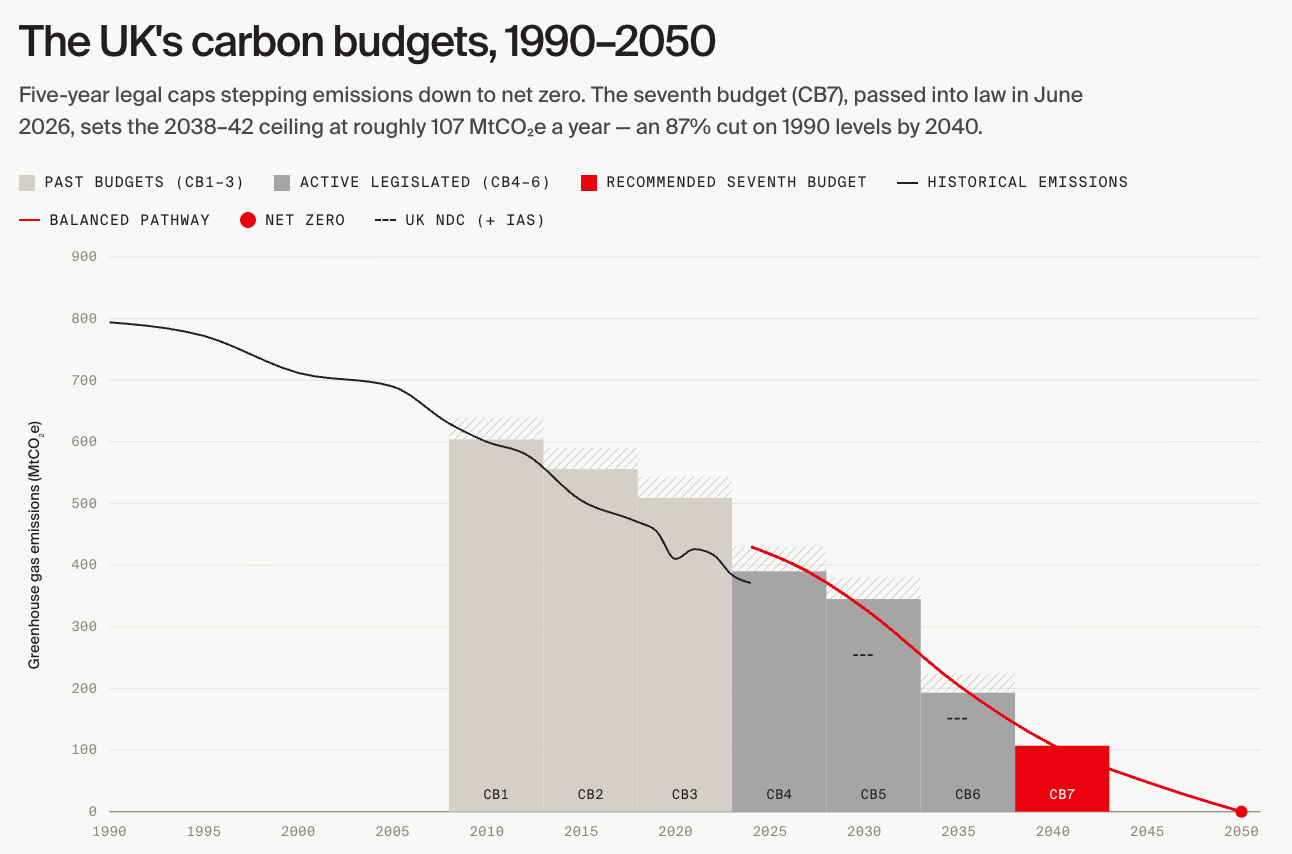
The newest of those is the headline number: the seventh carbon budget (2038–2042) was laid before Parliament on 2 June at 535 MtCO2e (note this is over the 5 years rather than a yearly amount), roughly an 87% cut on 1990 levels by 2040. Internationally, the UK’s pledge is a 68% cut by 2030 and 81% by 2035. On power specifically, the government’s Clean Power 2030 plan targets at least 95% of generation from low-carbon sources by 2030.
Where it actually sits today: renewables were 52.5% of UK electricity in 2025, the second year running above half, and territorial emissions are down about 54% on 1990 levels.
What the UK’s seventh carbon budget actually says
A carbon budget is a legally binding cap on the total greenhouse gases the UK can emit over a five-year period, set under the Climate Change Act 2008. The independent Climate Change Committee recommends the level, Parliament then votes it into law, and each budget is set roughly twelve years in advance so government and business can plan. Each one steps down towards net zero by 2050. Six have been set so far, covering 2008 to 2037, and the UK over-achieved on the first three.
The seventh (CB7) is the one for 2038–2042. The CCC recommended a cap of 535 MtCO₂e, including the UK’s share of international aviation and shipping, and described it as “ambitious but deliverable”. That works out as roughly an 87% cut on 1990 levels by 2040… the most ambitious 2040 target in the G7. In plain terms it’s the legal ceiling that locks in how fast the UK has to decarbonise through the late 2030s, eight years out from the 2050 net zero deadline.
The timeline as it stands for the carbon budget
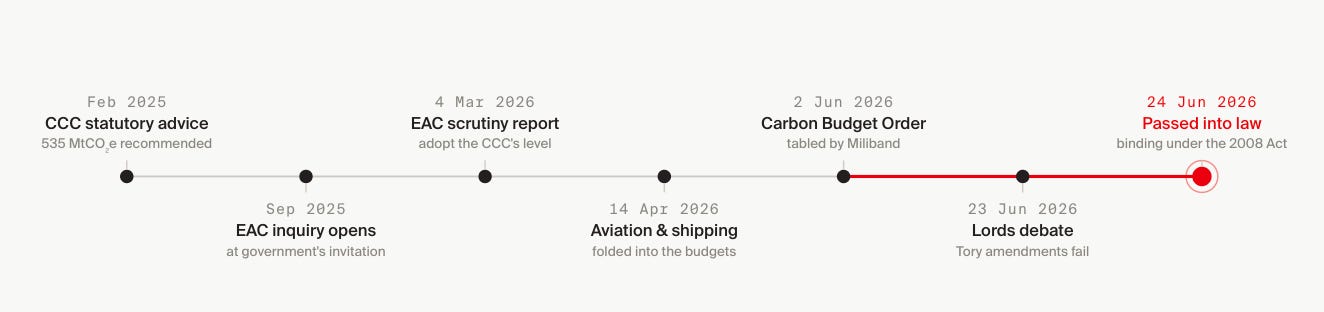
February 2025: the CCC publishes its statutory advice recommending the 535 MtCO₂e level.
September 2025: the Environmental Audit Committee opens its inquiry into CB7, at the government’s invitation.
4 March 2026: the EAC publishes its scrutiny report and recommends the government adopt the CCC’s level. (A separate CCC cost-benefit analysis followed on 11 March.)
14 April 2026: the government lays the instrument formally folding international aviation and shipping emissions into the sixth budget onwards.
2 June 2026: Ed Miliband lays the draft Carbon Budget Order before the Commons and publishes the government’s response to the EAC.
23 June 2026: the Lords debate the order; Conservative regret amendments are pushed but fail.
24 June 2026: Parliament passes CB7 into law, inside the 30 June statutory deadline set by the Climate Change Act.
Contextualising the UK’s targets compared to other G20 countries
Legally binding net-zero targets are now common.
Nine of the G20 (Australia, Canada, the EU, France, Germany, Japan, South Korea, Spain and the UK) have enacted net-zero legislation, and the EU passed its net-zero target into law via the European Climate Law in 2021. Germany and Sweden have gone further with binding 2045 dates. So a binding 2050 target is fairly standard company.
What’s distinctive about the UK is the mechanism, not the headline goal. The UK was the first major economy to put legally binding emissions targets in law: the 2008 Climate Change Act, with five-year carbon budgets stepping down to net zero, and an independent watchdog to mark the government’s homework. Germany explicitly followed the British model with its 2019 climate law, interim 2030 targets and its own expert council. Binding interim budgets with an independent adviser is a stronger accountability design than a single distant 2050 date, and it’s the bit other countries copied.
How has the UK delivered compared to countries with a similar framework?
The UK has one of the cleanest records. It met and over-achieved its first three budgets covering 2008–2022, with the third over-achieved by 391 MtCO₂e, or 15%, and it’s on track to over-achieve the fourth (2023–27). But two caveats matter.
The CCC’s own analysis is candid that the over-achievement was largely down to factors other than policy: a tighter-than-expected EU emissions-trading cap, weaker-than-expected GDP, and COVID.
Progress on the sixth budget and the 2030 target has been slow, with the government’s plan not achieving the 2030 NDC.
So the strong record is real but built on the low-hanging fruit.
France is the instructive contrast, with a bumpier delivery. It missed its first carbon budget (2015–2018), overshooting by 61 MtCO₂e, which led to a court ruling ordering the state to make good the overshoot. It then recovered: the second budget (2019–2023) was met, with average emissions of 406 Mt a year against a 425 Mt cap, more than making up the earlier overshoot (though partly COVID-aided) and France is not on track for the EU’s 2030 target, mainly because of transport.
New Zealand has the framework, i.e. three emissions budgets set in 2022 under the Zero Carbon Act with an independent commission, but the quality of compliance is the issue. It leans heavily on forestry offsets and plans to buy international credits to hit its targets rather than cutting emissions at source, and a court ruling freed the government from keeping its budgets aligned with 1.5°C, so “meeting” the budget there means something weaker than in the UK.
Taking a step back, who is emitting?
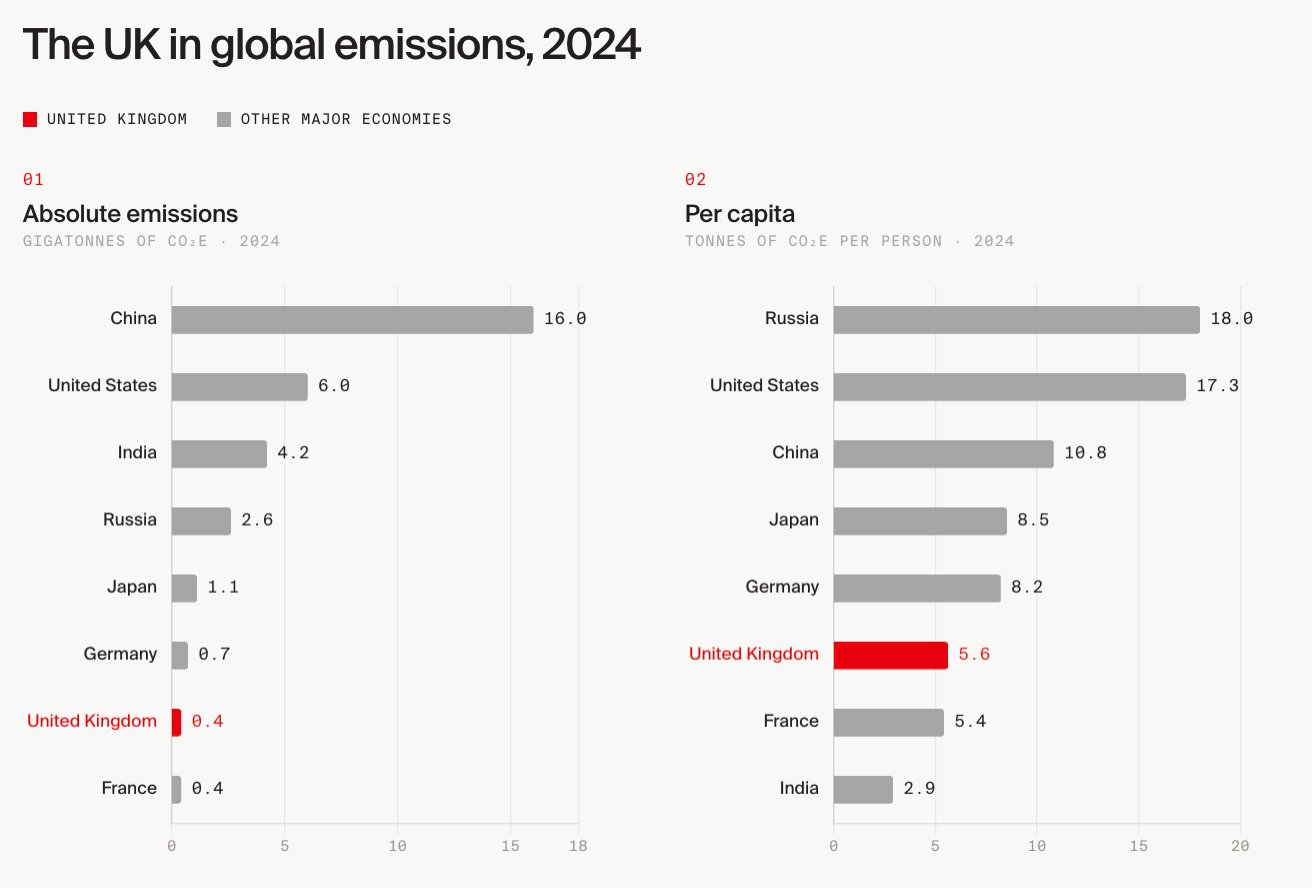
China is by far the largest single state, accounting for around 31% of global emissions. It doesn’t use a UK-style binding carbon budget. Its backbone is the “dual carbon” pledge, ie peak emissions before 2030, carbon neutrality before 2060. This is supported by the “1+N” policy framework and the Five-Year Plans, plus the world’s largest emissions-trading scheme, which started in the power sector and is expanding to steel, cement and aluminium. The notable shift is recent: China’s 2035 pledge, submitted in late 2025, is its first economy-wide absolute target, a 7–10% cut from peak emissions by 2035, and it signals a move toward absolute carbon limits and a possible carbon-budget system rather than pure intensity targets. So China is edging toward the budget logic, but the 2060 goal remains a pledge, not binding law.
The United States is the second largest, ~11% of global emissions. The US has withdrawn from the Paris Agreement, and there’s no federal legally binding emissions target or budget at all… only sub-national efforts (California and others) and spending programmes. Among major economies it’s the one moving away from a framework rather than toward one.
India is third, roughly 8% of global emissions. Its pledge is net zero by 2070, backed by an emissions-intensity target and large renewables goals, but it’s a pledge plus sectoral targets, not a binding net-zero law or a carbon budget. Like China, it frames climate action around intensity and development, not an absolute cap.